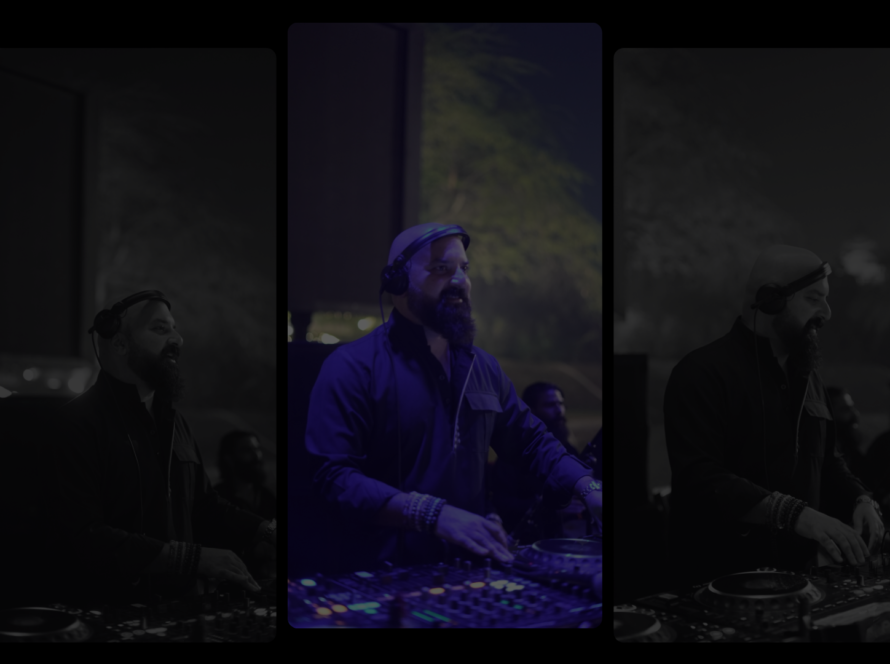
Stepping into a wedding venue with a console, a playlist, and a bit of confidence is exciting for any new DJ but excitement alone never carries a wedding night.
This is the moment where small mistakes get noticed quickly and good decisions get remembered for years.
DJ Sidharth has seen this happen across hundreds of high-pressure wedding shows, and his experience shapes the foundation of what every beginner can benefit from before touching their first wedding console.
Weddings in India are unpredictable.
Different age groups.
Different expectations.
Different energy zones.
A new DJ who understands these layers survives the night.
A new DJ who masters them grows into a booked-out wedding performer.
This guide pulls from DJ Sidharth’s on-ground expertise and breaks down five core areas every new DJ must understand before taking their first wedding gig.
1. Know the Crowd Before You Play the First Track
A wedding crowd is not a club crowd.
A wedding DJ who treats it like one is asking for trouble.
DJ Sidharth always explains that a wedding audience behaves in “waves,” and understanding these waves is the first skill beginners must practice.
Most new DJs worry about song selection. But song selection becomes easy when the crowd map is clear.
Here’s how experienced wedding DJs study the room:
- Kids usually warm up first and create early movement.
- Youth respond to beats, bass, and trending tracks.
- Parents prefer sing-along 90s, Shah Rukh-era romance, and iconic dance numbers.
- Elders want familiarity and clarity, not heavy drops.
New DJs often assume everyone will respond to the same playlist.
This is never true.
The crowd is mixed, and expectation is mixed with it.
DJ Sidharth teaches beginners to watch micro-signals: foot taps, head nods, small groups forming, sudden movement near speakers. these tiny reactions forecast the next big shift.
Once the DJ understands these signals, the night becomes smoother.
2. Build Setlists That Move Like a Story, Not a Random Playlist
Most new DJs focus on downloading trending tracks.
But trending tracks fall apart without structure.
A wedding setlist must feel like a guided journey, not a playlist on shuffle.
DJ Sidharth explains this through a simple sequence:
- Warm-up energy
- Family-friendly groove
- Youth-driven peak
- Bride/Groom spotlight
- Group dance circles
- Final high
- Soft landing for closing
This structure keeps chaos under control. It also builds trust with families who expect flow, not noise.
New DJs often panic when the energy drops.
A well-designed setlist solves that panic.
It gives the DJ a fallback plan when requests clash or when the dance floor splits into different age groups.
Beginners must also learn how to balance Bollywood, Punjabi, Commercial, Hip-hop, and regional requests.
Weddings in India demand versatility.
A DJ who locks into only one genre rarely gets rebooked.
Story example:
During a large Delhi wedding, DJ Sidharth noticed the dance floor suddenly thinning during a high-tempo section.
Instead of pushing harder, he pulled back with familiar 90s classics.
Within seconds the parents started dancing, which pulled the youth back.
Energy recovered without forcing it.
This is why setlist flow matters more than loud drops.
3. Technical Prep Saves You From Embarrassing Moments
Most DJs fear the crowd.
But experienced wedding DJs fear the console more.
One technical glitch at the wrong moment can ruin the night.
DJ Sidharth teaches new DJs to treat technical preparation like a ritual, not a checklist.
Here’s what beginners often forget:
- Testing microphone clarity before guests enter
- Backing up tracks in two separate devices
- Checking crossfader smoothness
- Evaluating monitor speaker placement
- Confirming power sources with the event team
- Adjusting gain levels to avoid distortion during high peaks
Beginners focus heavily on transitions and beat-matching. But weddings expose technical weaknesses much faster than mixing weaknesses.
Microphone issues during a couple entry.
Sudden distortion during a high-energy moment.
A laptop freeze during a family performance.
These things destroy confidence instantly.
DJ Sidharth always carries contingency tools like extra cables, backups, duplicate playlists, and even emergency tracks for sudden energy drops.
This is the level of preparation that separates amateurs from professionals.
Quick checklist (use only when needed):
- Backup USB
- Backup laptop
- Tested mics
- Organized folders
- Emergency dance numbers
- Battery check for controllers
Visual suggestion:
Infographic titled “DJ tips for beginners: Wedding Night Technical Prep Essentials.”
4. Communication Is 50% of a Wedding DJ’s Job
Playing great music isn’t enough at a wedding. A new DJ who doesn’t communicate with families, planners, and performers will end up confused at some point in the night.
DJ Sidharth’s wedding gigs are smooth because he communicates early, clearly, and respectfully.
This includes:
- Knowing the flow of ceremonies
- Understanding couple entries
- Coordinating with choreographers
- Getting clarity on “no-play” song lists
- Confirming family performance tracks
- Asking about special requests in advance
This clarity prevents last-minute surprises.
It also helps new DJs avoid mistakes such as:
- Playing a breakup song during a couple dance
- Cutting a family performance too early
- Playing genres the family dislikes
- Missing a spotlight moment due to miscommunication
Wedding clients notice these small details more than transitions or drops.
Good communication also builds reputation.
Most of DJ Sidharth’s referrals come from families who appreciated clarity, not just the music.
5. Adaptability Is the Real Skill That Gets a Wedding DJ Booked Again
No wedding goes exactly as planned.
Timelines change.
Ceremonies run late.
The couple wants to dance at the wrong moment.
A guest suddenly requests an old folk song.
Kids run around the console.
A playlist doesn’t match the crowd mood.
New DJs who panic lose control quickly.
But DJs who adapt gain respect instantly.
DJ Sidharth explains adaptability as “listening with your eyes.”
This means watching the crowd more than the screen.
Adaptability shows up in moments like:
- Switching genres on instinct
- Slowing down high energy for elders
- Extending a track when the dance floor peaks
- Cutting a track early when the crowd disconnects
- Changing the set order to match wedding flow
- Adjusting mic tone for different performers
This ability doesn’t come from software. It comes from experience and awareness.
Beginner DJs who embrace adaptability grow faster than DJs who hide behind playlists.
Story example:
At a Jaipur wedding, a planned performance was delayed by thirty minutes.
Instead of losing momentum, DJ Sidharth created a mini-celebration set mixing Bollywood favourites.
The delay went unnoticed.
The family appreciated the recovery more than the original plan.
Final Thoughts
Wedding gigs look glamorous from the outside, but they demand precision, awareness, patience, and technical discipline.
DJ Sidharth’s experience shows that new DJs don’t need massive gear or advanced mixing skills to succeed.
They need understanding.
They need structure.
They need preparation.
And they need the ability to read people, not just BPM.
Anyone wondering how to become a wedding DJ must start by respecting the complexity of weddings.
Anyone searching for DJ tips for beginners must learn to observe before performing.
Anyone looking for real wedding DJ advice must practice the fundamentals that DJ Sidharth has relied on for years.
These five principles are more than tips. They are survival tools for the first gig and success tools for every gig after that.